






Challenges in Production Planning
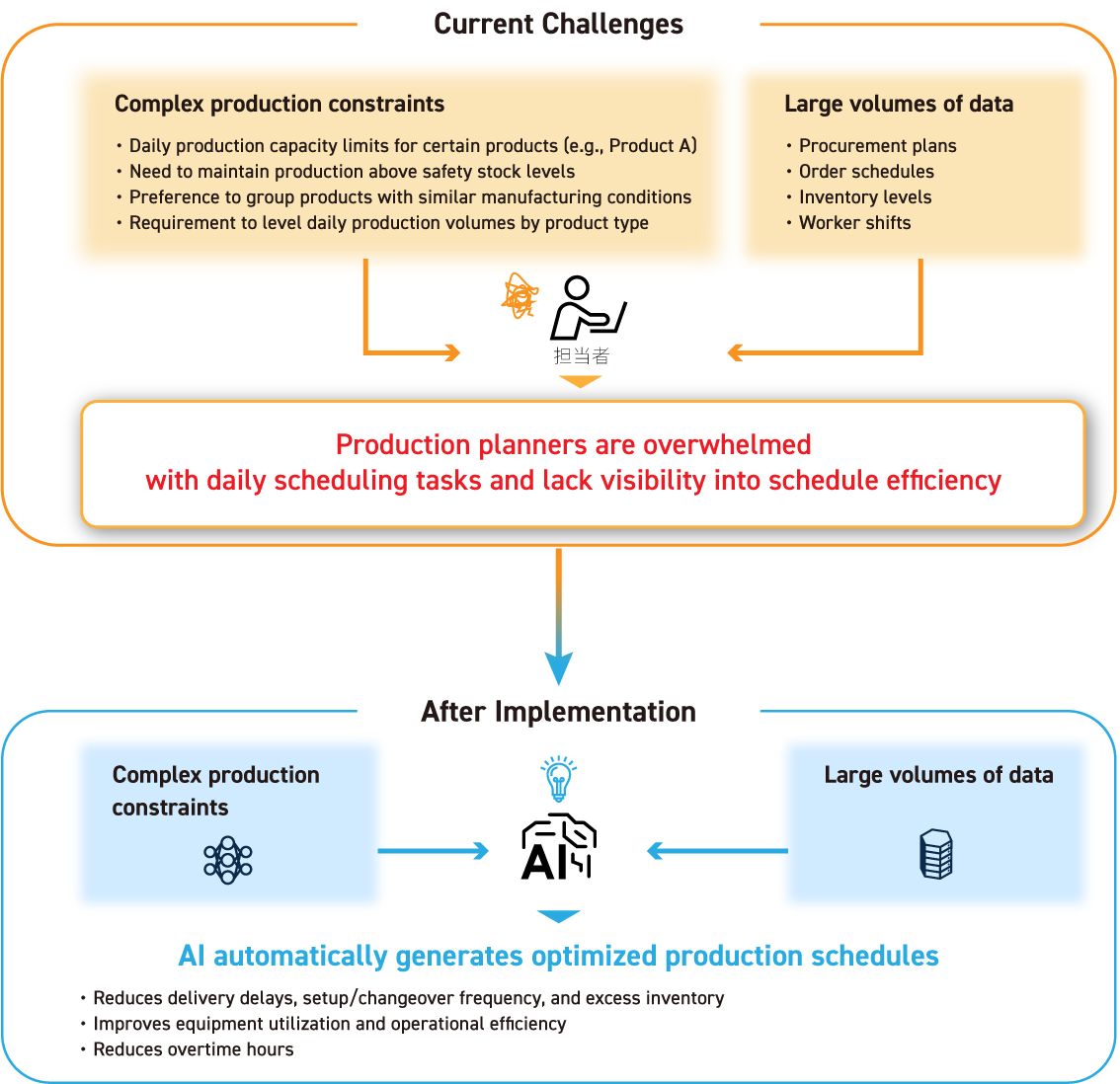
Production planning requires meeting targets such as on-time delivery and improved equipment utilization amid vast amounts of data and complex production conditions,
making it a highly specialized and time-consuming task.
The high level of expertise required has led to over-reliance on specific individuals, and combined with the labor shortages facing today’s manufacturing industry, developing and securing successors has become increasingly difficult.
Many companies have attempted to automate by adopting off-the-shelf schedulers from other vendors, only to find that these solutions could not accommodate the specific rules of their operations.
Moreover, even when on-site know-how exists for creating efficient schedules, verifying whether they are truly optimal is extremely difficult.
- Highly specialized work makes it difficult to develop and retain qualified personnel
- Off-the-shelf schedulers cannot accommodate the detailed rules of your specific operations
- It is unclear whether the production plan is truly “optimal”
VRAIN Solution Can Develop
an AI-Powered Optimal Production Scheduler
RAIN Solution specializes in services tailored to the manufacturing industry.
This deep manufacturing expertise allows us to accurately understand on-site needs and develop production schedulers that are truly “operational in practice.”
Furthermore, by leveraging advanced AI technology, we are able to create production schedules that are “genuinely optimal.”
Case Studies
Reduce Wait Times and Improve Equipment Utilization Through Input Sequence Optimization
| Company | Electronic Components Manufacturer |
|---|---|
| Background & Objective | ・A single person is manually creating daily production plans for hundreds of machines and thousands of lots, placing a heavy burden on that individual ・Priority production items arise several times per month, requiring the plan to be completely rebuilt each time ・One worker handles setup for 10 machines, but overlapping setup times create idle periods |
| Results | ✅ Planning time reduced by 8 hours/day ✅ Equipment utilization improved by 1.5% ✅ Yield rate improved by 1% |
Implementation Flow
1
Understanding Current Situation & Challenges
2
Defining the Ideal State
3
Verification of Optimization Calculations
4
Deployment & Operation


